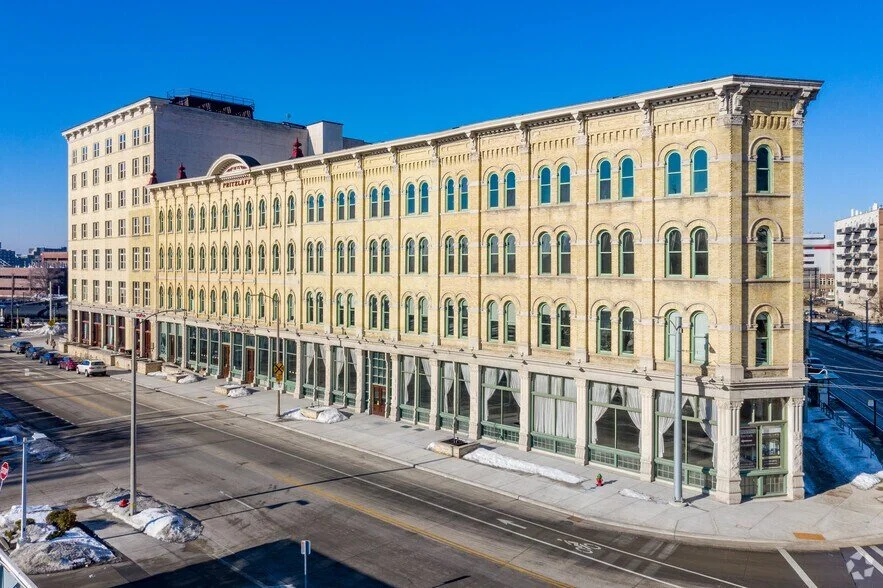
The Historic Third Ward is Milwaukee's preserved warehouse district, and its building stock is defined by cream city brick and heavy timber construction dating to the late nineteenth century, now carrying loft apartments, galleries, and retail behind facades protected by historic district review. An exchange out of Third Ward property involves questions a newer building simply does not raise.
Cream City Brick and the Third Ward's Warehouse Stock
Most Third Ward commercial buildings use load-bearing cream city brick exterior walls with heavy timber post-and-beam interior framing, originally built for warehouse and light manufacturing use before conversion to retail, office, and residential space. These assemblies age differently than modern steel or concrete construction, and mortar joint condition, timber moisture history, and masonry tuckpointing records all matter more here than in a typical suburban building.
Roof systems on converted Third Ward buildings are almost always low-slope, replaced over the original timber deck, and a seller should know whether the roof structure has been reinforced to carry rooftop mechanical equipment added during conversion, since older timber decking was not always designed for that load.
Property Types Inside a Preserved Commercial District
Owners exchanging out of Third Ward property typically consider a specific set of candidates suited to the district's preserved character:
- converted warehouse buildings with loft apartments above retail
- ground-floor retail and gallery space
- office conversions inside historic timber-frame buildings
- mixed-use buildings with structured parking
- riverfront-adjacent commercial buildings
A Third Ward seller should confirm which historic district requirements apply to a replacement candidate if it is also inside a protected district, since exterior modification rules can differ meaningfully by building and jurisdiction.
Structural and Code Questions on Converted Warehouses
Before naming a Third Ward building as relinquished or replacement property, a seller's team should confirm masonry tuckpointing history, timber moisture and pest inspection records, and whether life-safety systems added during conversion meet current code for mixed residential and commercial occupancy. None of this affects like-kind eligibility, but a lender's property condition assessment on a historic timber-frame building will look closely at these items, and a seller who has them documented moves through underwriting faster.
Sprinkler coverage and fire-rated separation between residential and commercial uses in a mixed-use conversion are worth confirming early as well, since retrofitting either after a replacement candidate is under contract can delay closing inside the 180-day window.
Financing and Historic-Building Considerations
Lenders financing Third Ward property generally require a more detailed property condition report than for newer construction, given the age of the masonry and timber systems involved. A seller should confirm early whether a target replacement candidate's financing terms will match the debt paid off on the relinquished Third Ward property, since any shortfall not offset with additional cash is generally treated as boot.
Where a Third Ward building has previously used historic tax credits for renovation, a seller should also confirm any recapture exposure tied to a sale within the credit's compliance period, since that is a separate consideration from the exchange itself and worth raising with a tax advisor before closing.
Sequencing a Third Ward Exchange Against Premium Pricing
Third Ward property often trades at a premium relative to other Milwaukee submarkets because of its preserved character and location, which can leave a seller with sale proceeds that exceed what a single replacement candidate requires. Sequencing the identification list to include a mix of asset types and price points, and sharing structural documentation with the qualified intermediary early, keeps the 45-day and 180-day deadlines from becoming a scramble.
Because timber-frame and cream city brick buildings are unique enough that direct comparables can be scarce, a Third Ward seller's appraisal often takes longer to complete than a straightforward suburban assignment. Building extra time into the diligence schedule for that appraisal, and confirming early which replacement candidates outside the district might also serve the investor's goals, keeps the search from narrowing too quickly around buildings that share the same masonry and timber age questions as the one being sold.
Common 1031 Exchange Questions
Does a historic district designation affect whether a Third Ward building qualifies for a 1031 exchange?
No, historic district status does not affect like-kind eligibility for real property. It does affect what exterior modifications are allowed and how a lender evaluates the building, so a seller should factor that into the diligence timeline.
What structural records matter most for a Third Ward warehouse exchange?
Masonry tuckpointing history, timber moisture and pest inspection records, and documentation of any structural reinforcement added during conversion are the items a lender's property condition report will focus on most closely.
Can a Third Ward loft building owner exchange into a different Milwaukee submarket?
Yes, like-kind treatment for real property is not limited to a specific neighborhood or building type, so a Third Ward owner can identify replacement candidates anywhere that meets the investment or business use requirement.
How does the 200 percent rule apply to a premium-priced Third Ward sale?
If a seller identifies more than three replacement candidates, their combined value must stay within 200 percent of the relinquished property's sale price, which matters in the Third Ward given the premium pricing common in the district.
What is the timeline for closing a replacement purchase after selling in the Third Ward?
An investor has 45 days from closing on the relinquished property to identify replacement candidates in writing, and 180 days total to close, with both periods running concurrently and not extended for historic-building diligence delays.